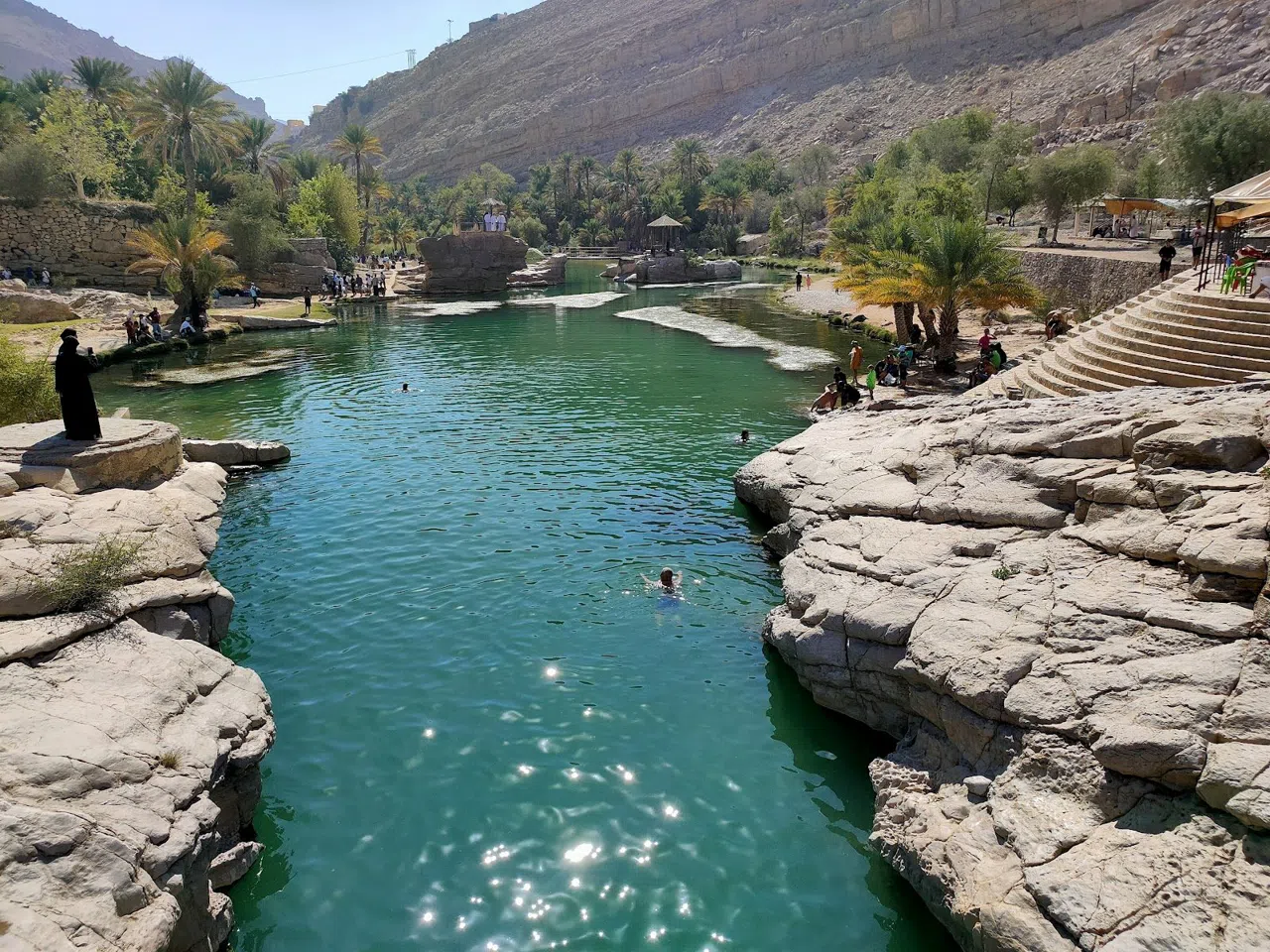
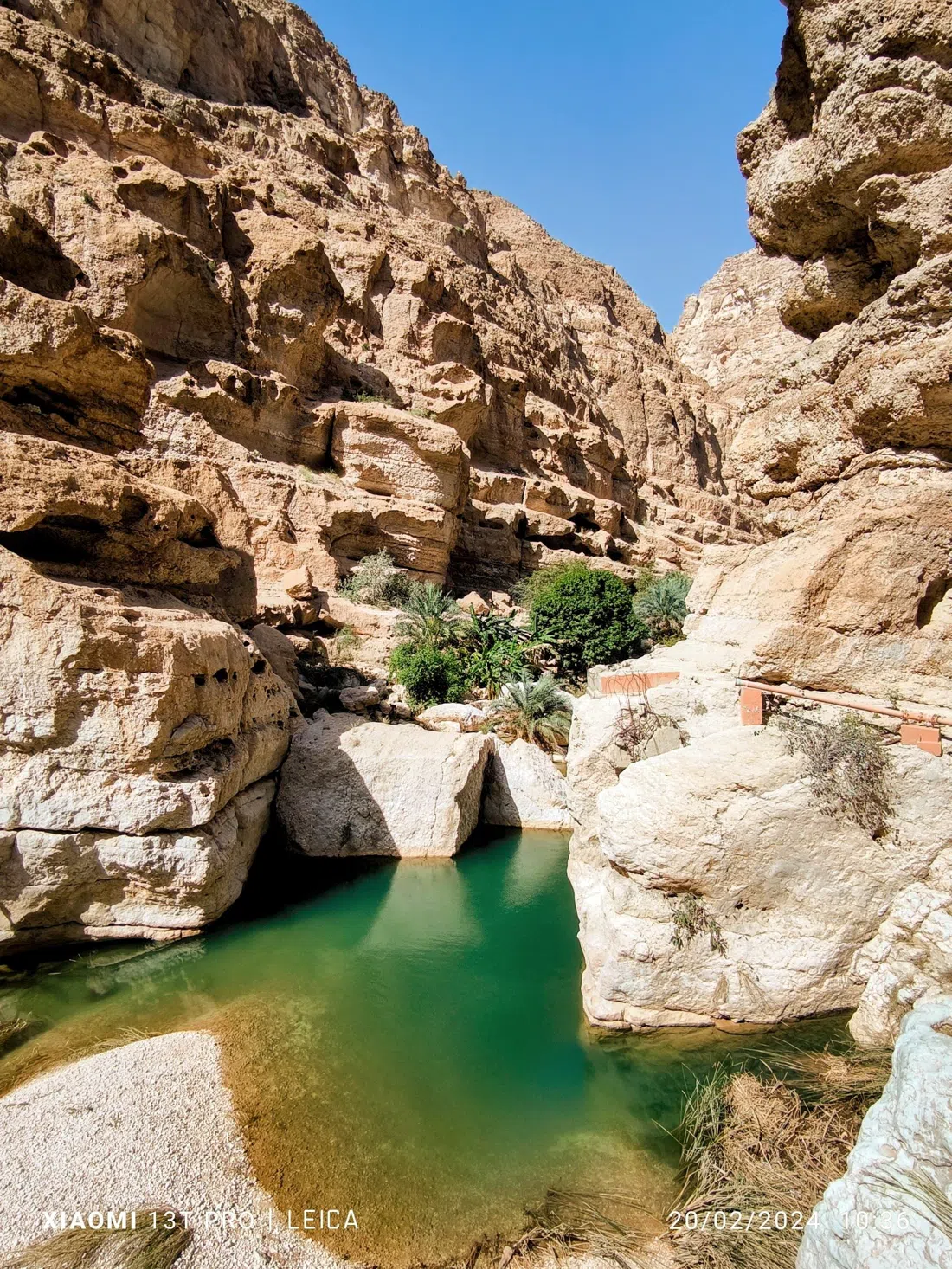
The last stretch of road climbs through a notch in the Hajar mountains, drops into a palm-floored valley, and ends at a car park with no barrier and no ticket office. Five minutes later you are standing over water the colour of bottle glass, clear enough to count the stones on the bottom, walled in by rock that keeps the lower pool in shade until mid-morning. Nearly everyone stops at that first pool, and that is the most useful thing to know before you come.
What the wadi actually is
Wadi Bani Khalid (Muqal Pools), in the Al Sharqiyah interior roughly two and a half to three hours inland by road, is a spring-fed gorge that holds water all year, which is rare in this part of the country. That reliability is why the villages below it still farm three irrigation channels off the same flow instead of treating water as a seasonal gift. What the visitor sees is a tidied front end: a paved path, a footbridge, concrete steps, and a terrace restaurant at the point where the engineering stops and the boulders start.
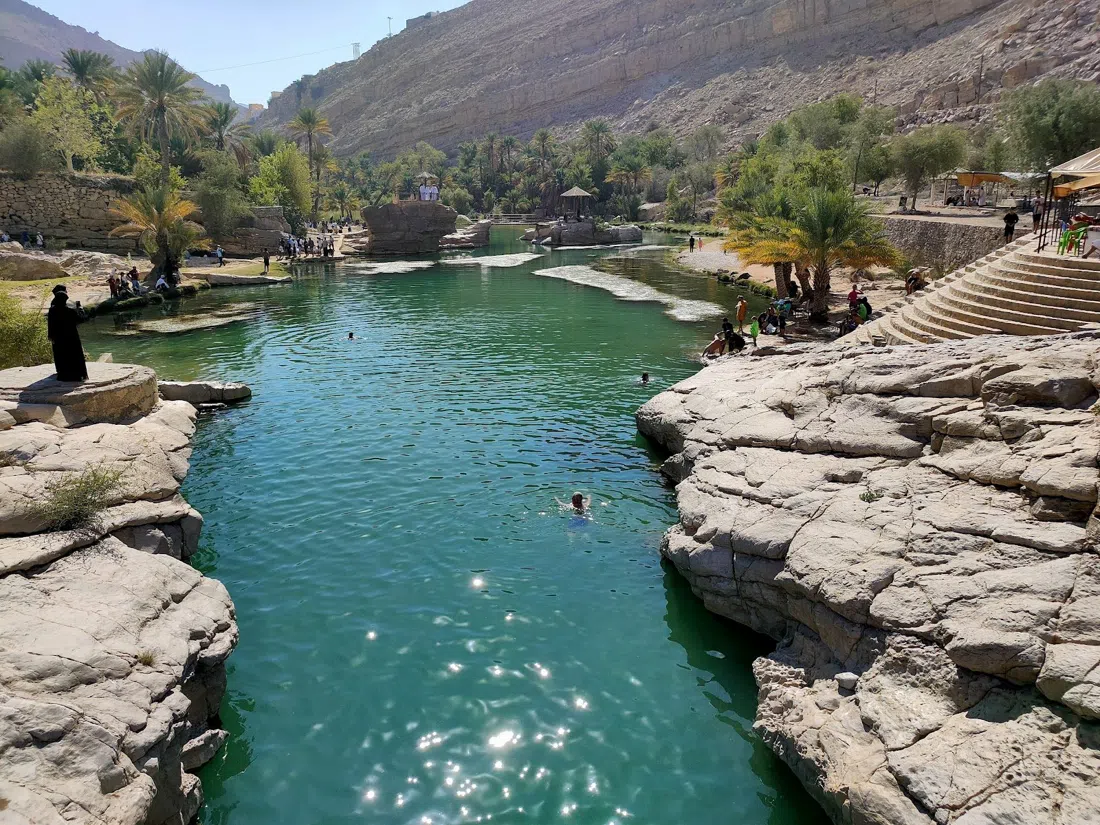
From the marked parking area it is about five minutes of flat, easy walking to the main pool. There is no gate, no booking and no ticket desk. Entry runs from free to around 500 baisa per person, collected at the car park, about USD 1.30, and nothing on site takes a card. Toilets are roughly 400 baisa, a changing tent 100 baisa. Bring small notes and coins or you will be doing the whole thing in wet clothes.
The honest time estimate splits in two. Half an hour is enough to look at it, take the photograph everyone takes from the footbridge, and leave. Two to three hours is what it costs to actually swim up the canyon. Half an hour makes it a coach stop; the longer version is the one worth driving for.
Getting past the first pool
The main pool is deep enough to swim properly and pleasantly warm by the afternoon, and by late morning it holds a crowd. The upper pools and boulder canyon, straight on past the restaurant terrace, are where that crowd is not. Ten to twenty minutes of scrambling over wet, polished rock buys genuine quiet, and a pool reached by a fixed rope just off the main line stays empty even at the busiest hour of the day.
This is not a hike in any technical sense. There is no gate, no permit and no route to find. It is simply slippery. Wear shoes with grip; flip-flops are how people spend the rest of the trip sitting on a rock with a cut foot. Guides routinely split larger parties here, and beyond the second pool it is small, agile groups only. That is also why the upper canyon never fills: no group timetable survives slick rock and single-file boulders.
The cave is optional, and plenty of people skip it
Muqal Cave (Kahf Muqal), up concrete stairs about 350 m beyond the last pool and roughly 1.45 km in from the car, is unstaffed, ungated and free. You need a torch and a willingness to crouch in the dark on wet rock. It is too tight for a group to move through comfortably, so guides take two or three people in at a time while the rest wait outside.
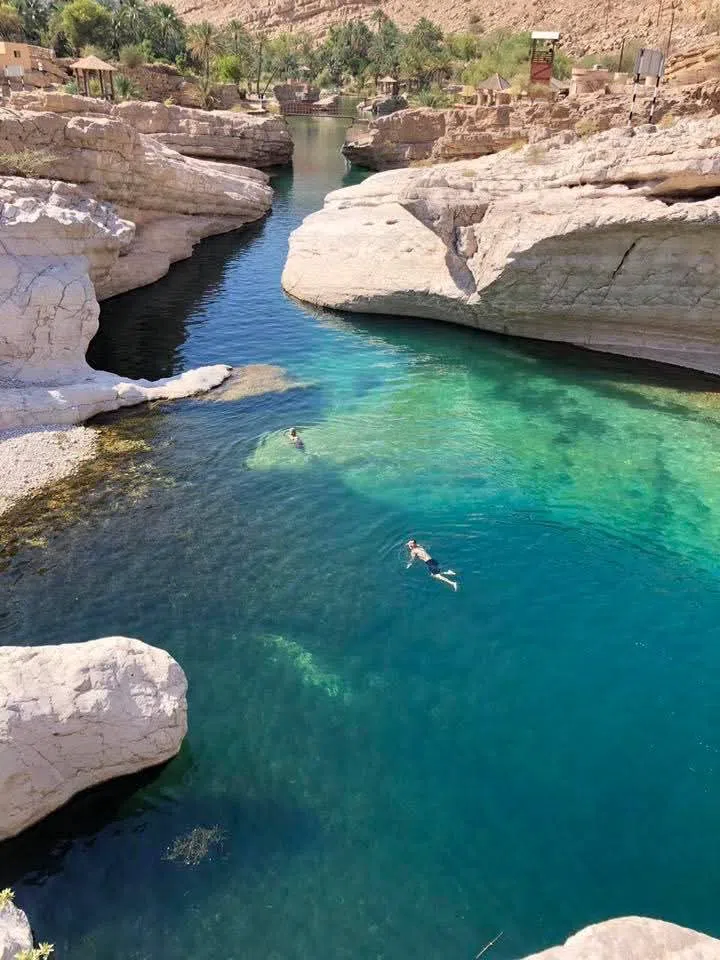
It is a short, rough cavity rather than a show cave: no lighting, no walkway, and no chamber at the end to reward the climb. If you have two hours at the wadi, spend them on the pools, and a lot of visitors who make the climb say the same afterwards. Go in if caves interest you for their own sake, not because it is listed as a thing to do.
Food, toilets and the last tap
The pool-side restaurant terrace, above the main pool and before the boulders, is the only food on site, and it is set up for tour parties. Buffet service moves people through quickly, which also means it is at its worst in the midday peak. Buffet lunch is around 4 OMR, about USD 10; coffee 1 OMR; soft drinks 400 baisa; towel hire 1 OMR. Cash only, like everything here.
Its real importance is logistical. The toilets sit behind it, and this is the last point with any facilities before the upper canyon. Fill your water bottles here. Past the terrace there is no shade structure, no tap and no bin, and in the dry months the walk back from the upper pools is longer than it felt on the way up.
The door versus a guided day
There is no queue to skip at Wadi Bani Khalid, because there is nothing to queue for. Nobody sells a timed ticket, nobody counts heads, and the car park is large and free. Access is not the problem; company is. Organised minibuses land from around 10 to 10:30 and the lower pool fills fast.
So booking ahead buys something other than entry: a driver who knows the inland route, an early departure that beats the minibuses, and the option of adding the desert to the same day without driving a hire car into sand. Private full-day trips here start from 208 USD per person and run seven days a week, and there are 1,206 traveller reviews across the bookable options, so this is a well-worn route rather than an experiment. Self-driving is entirely reasonable too: the road to the car park is sealed and a 2WD is fine. The trade is that you drive the three-hour return leg yourself after a day of swimming.
Rules, modesty and what to wear
The pools are a family swimming site rather than a resort beach, and local families use them heavily. Swim in shorts and a t-shirt, men included and women especially, and change in the 100-baisa tent rather than behind a rock. Nobody will police it, which is why getting it right matters.
Take everything out with you. There is no bin service past the restaurant, and the litter you can see in the lower pool area was all carried in. Alcohol is not appropriate here. Leave drones in the car: you are swimming above a working village, not in a park.
Pairing the pools with the sands
Most private trips to the wadi run eight hours because they add the dunes, and that is what stretches the day. Al Sharqiyah Sands (Wahiba Sands) dunes at Bidiyah lie around 35 to 40 km from the wadi turn-off, and operators run 4x4 dune drives for several vehicles at a time from the tyre-deflation stops on the edge of the sand. Expect roughly 40 to 50 OMR per person where a dune drive and a camp transfer are bundled into a full day. Do not drive into the sand in a hire car under any circumstances: the recovery bill is real, and so is the insurance exclusion.
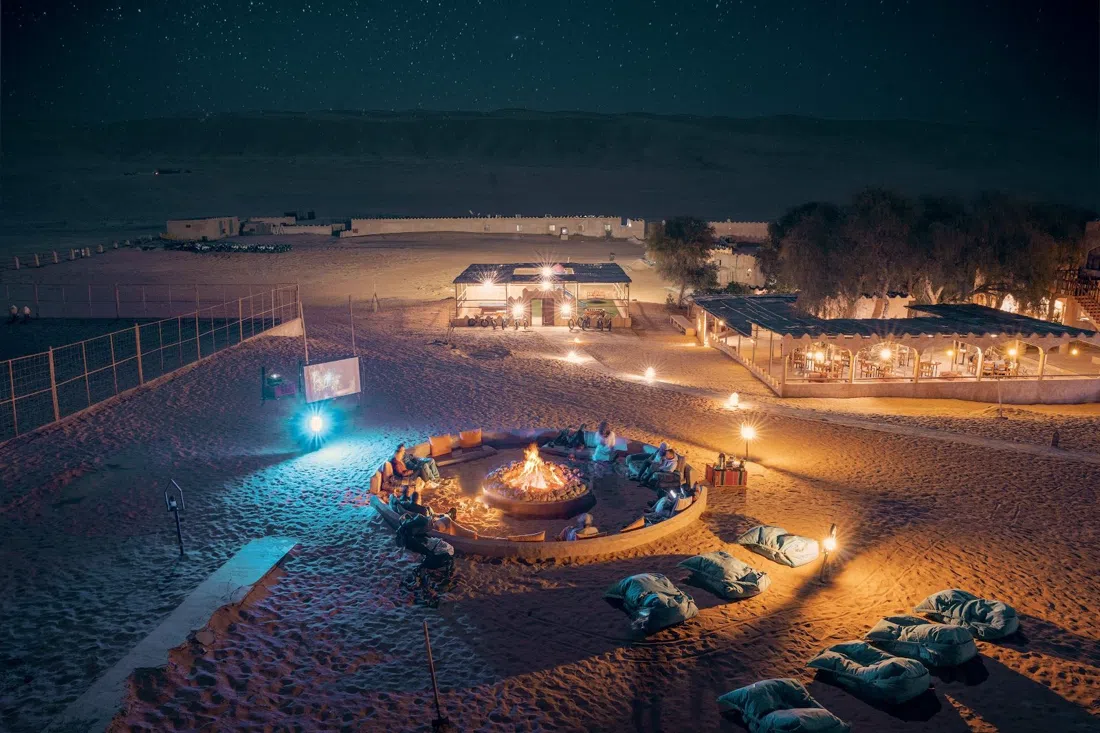
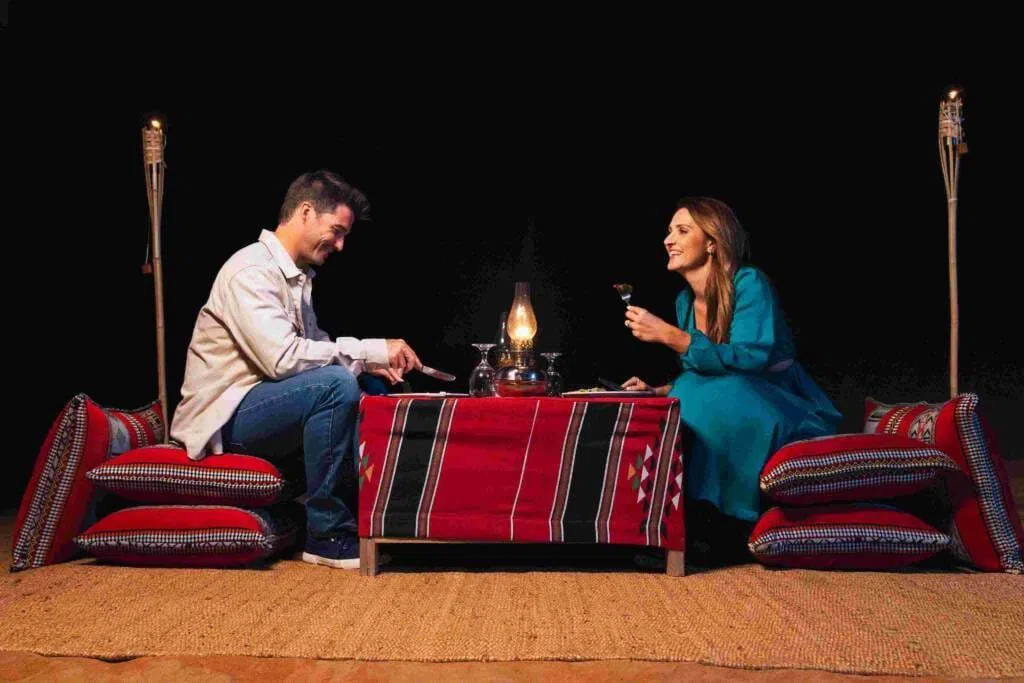
Thousand Nights Camp, on the Bidiyah side of the sands, is the established group option: camel rides, sand boarding, fat biking, Bedouin coffee and shua lamb dinners, with private tent dining if you are two rather than ten. You can reach a transfer point in a 2WD and hand over from there. The hours people actually remember are sunset through stargazing, so it only makes sense if you stay for dinner.
Desert Nights Camp, deeper into the sands at Al Wasil, is the upscale counterpart, capped at 64 guests across 33 double tents, 6 family tents and 14 rooms, with five-star rates from roughly EUR 70 per person per night depending on season. It is comfortable for a small group and far too small for a coach. It is also a hotel in a dune field rather than a rough camp, so pick it for the bed and not for the authenticity.
The villages below the pools
Muqal and Bidah villages, immediately below the gorge mouth, are lived-in working settlements rather than an attraction, and they deserve to be treated that way. A quiet walk-through with a guide is fine; unloading a party of twenty is not. The three irrigation channels fed by these pools are still farmed, and the donkey track above Muqal gives the view down the gorge that no photograph from the water can get. Keep cameras off houses and off people.
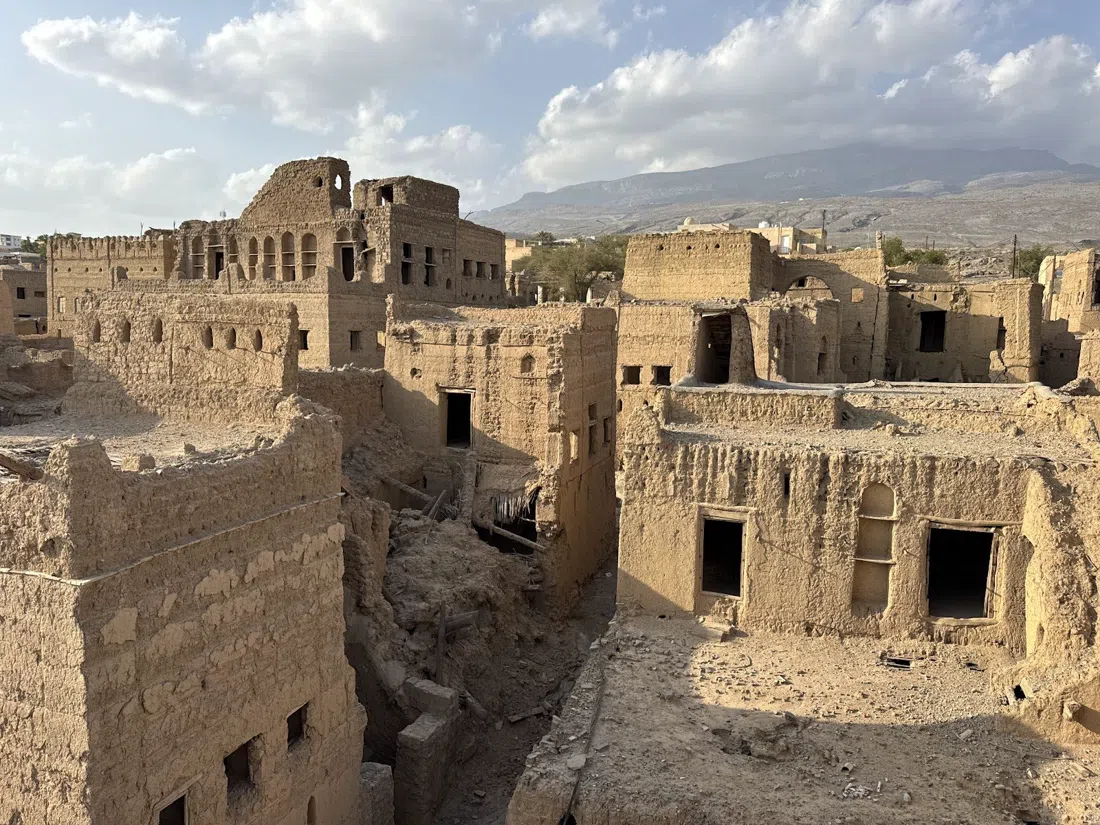
Al Mudayrib old village, on the inland road back, costs almost no detour, about ten minutes off the route, and has no gate, ticket or opening hours. Small groups wander the alleys between mudbrick towers, and a few coffee shops in restored houses open in the late afternoon. Go early morning or after 5pm for the light and the shade, and watch your footing in the unrestored sections, where floors are genuinely missing.
If you want effort instead of a paddle
Wadi Hawer, the south side of the Bani Khalid system, is the serious alternative: a real three-to-six-hour swim-and-scramble for a fit, small party. It is free to enter and a private guide costs roughly 25 to 40 OMR for the group, which is the best money you will spend on this trip if this is the day you want.
Do not attempt it unsupervised. There is no marked route, no phone signal worth relying on, and no one coming to look for you. Go with a guide.
The coast-road way home
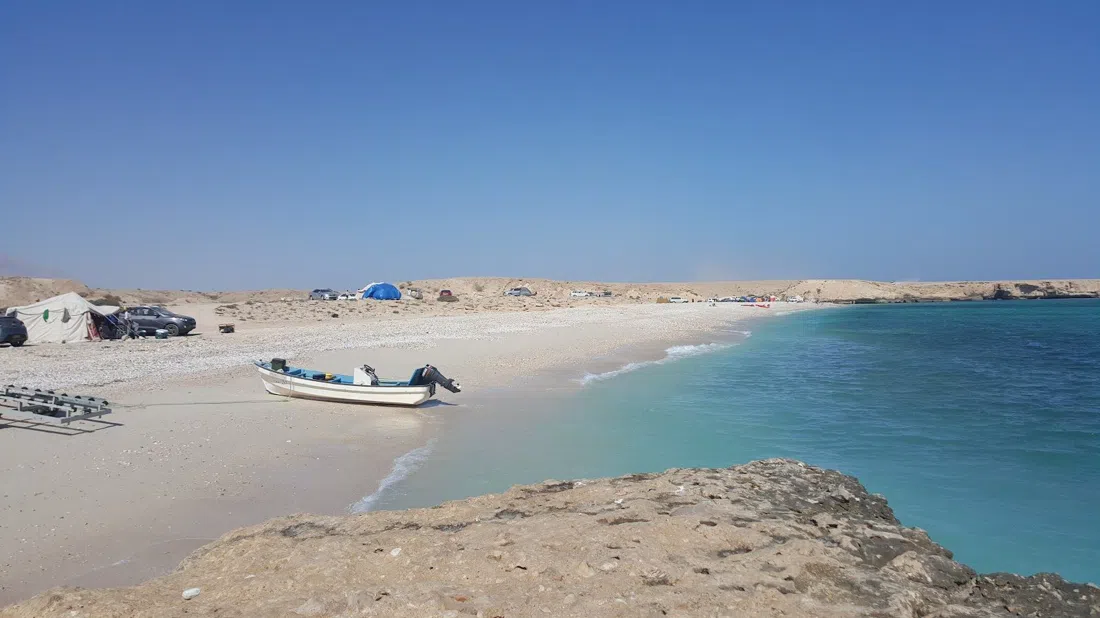
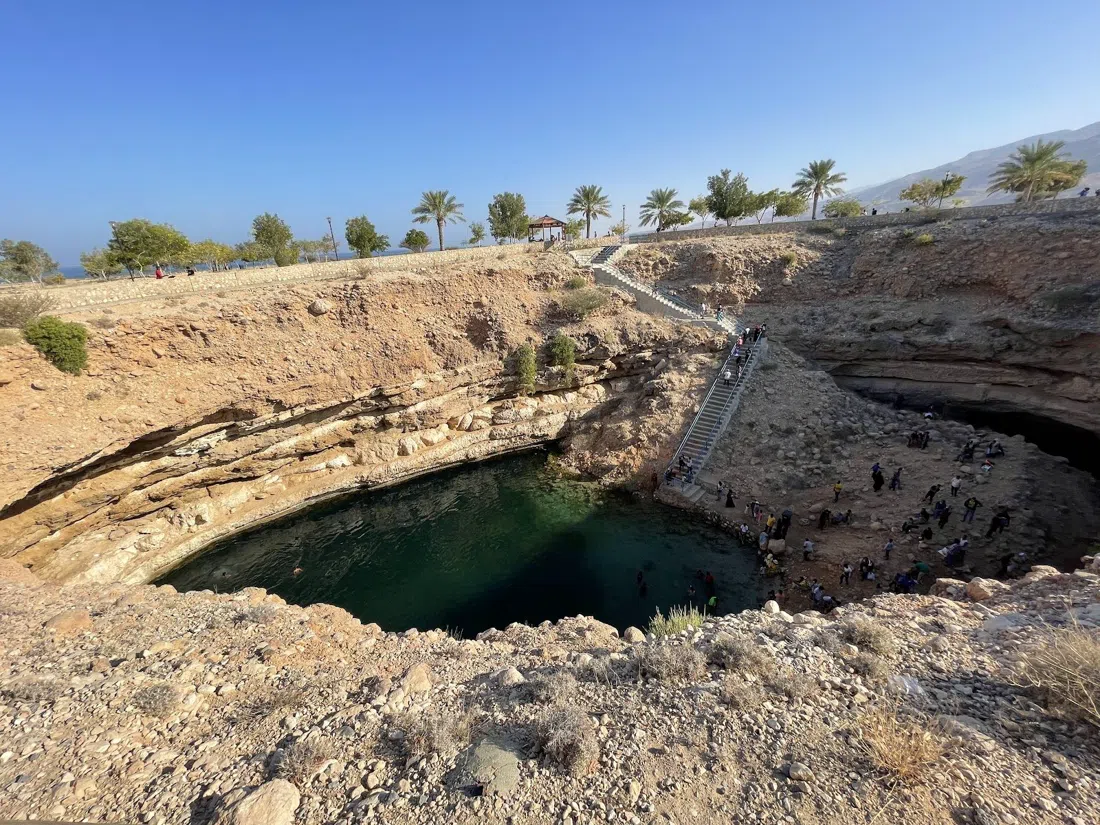
If your driver returns to the capital along the coast instead of the inland road, three stops earn their place. Bimmah Sinkhole (Hawiyat Najm Park) is a free public park with parking, restrooms, changing rooms and picnic pavilions, open daily roughly 08:00 to 20:00, free to 500 baisa per person. It handles tour groups easily and thirty minutes is plenty. Fins Beach (White Beach) is unmanaged, open day and night, free, and has no facilities at all, which makes it useful for a late lunch or sunset. Swim carefully: the pebbles drop away sharply and there are no lifeguards.
Sunaysilah Castle, out on the Al Sharqiyah coast above the working dhow yards, is a small ticketed fort at around 0.5 OMR per person, open roughly 07:30 to 17:30 on its open days. Its open days are limited, so confirm before routing anyone there. Pair it with the shipyard and the lighthouse across the creek.
Wadi Shab is the stronger wadi, and it is worth saying plainly. It is harder, wetter and more spectacular at the end, with a 1 OMR boat crossing each way, boats running about 08:00 to 17:00, and a final cave squeeze that is single-file and needs real swimming ability plus a dry bag. It is a separate day rather than an add-on. Bani Khalid is the one you can do in sandals with children; Shab is the one you train slightly for.
Staying the night at the wadi
Wadina Resort, in Muqal minutes below the pools, opened in 2025 and is the only genuine reason to sleep at the wadi rather than drive back. It is a small property, best booked ahead, and it takes families and small groups; day visitors can use the restaurant. Rates start from roughly USD 125 per night.
The argument for it is narrow and strong: stay over and you have the pools to yourself at 7am, three hours before the first minibus. The argument against is just as simple. You give up a night in the capital, where the hotel choice is wider and the next day's options are closer. Compare both on the Muscat hotel search before deciding; for most people a 6am start from the city wins.
Best time to go
Arrive before 10am. That is the whole strategy. Organised minibuses land from around 10 to 10:30 and the lower pool fills quickly, so a 6 to 6:30am departure from the city puts you on the footbridge in near-silence with the gorge walls still shading the water.
For the season, October through April is the comfortable window for a long inland drive and a swim. The water is cool year-round, but the walk back in summer afternoon heat is unpleasant. The wadi holds water through summer even so, which is more than most can say. Avoid Fridays and public holidays if quiet matters to you: local families use the pools properly on their days off, and that is their right. Early, midweek and outside a public holiday is as good as it gets. If you are photographing rather than swimming, swim first and shoot mid-morning, when light finally drops into the gorge.
Is it worth it
Yes, on one condition: you have to walk past the restaurant. Judged on the lower pool alone, this is a pleasant, over-photographed swimming hole that does not justify six hours of driving. Judged on the upper canyon, with its rope pool, its boulder scrambling and nobody there, it is one of the better half-days in the country.
It suits families with swimmers, couples who want water rather than monuments, and anyone who would rather spend a day in a gorge than a museum. It does not suit non-swimmers hoping for a spectacle, people who cannot manage wet rock, or travellers on a tight single day in the capital, for whom the inland drive eats the day. If you want difficulty, do Wadi Hawer with a guide. If you want the more dramatic wadi, give Shab its own day. For deciding where this fits against everything else nearby, the Muscat guide is the place to start.
Practical notes
Transport is simple. The road is sealed all the way to the car park, a 2WD is fine, and the lot is large and free. Figure two and a half to three hours each way from the capital, more if you add the sands. No public transport gets you there and back in a day, so it is a hire car or a driver.
Bring small Omani notes and coins. Entry up to 500 baisa, toilets about 400 baisa, changing tent 100 baisa, towel hire 1 OMR, coffee 1 OMR, buffet around 4 OMR. Nothing on site takes cards, and there is no ATM.
For timing, leave at 6am, swim 8 to 10am, eat at the terrace before the midday rush, and keep the upper pools for after lunch if you still have legs. Two to three hours at the wadi is the minimum; eight hours door to door with the dunes attached.
On budget, a couple self-driving can do the wadi for under 15 OMR all in, including fuel, entry and lunch. A guided private full day starts from 208 USD per person. A bundled dune drive and camp transfer runs roughly 40 to 50 OMR per person. A guide for Wadi Hawer is 25 to 40 OMR for the group.
Pack grippy shoes you can soak, modest swimwear, a towel, a torch for the cave, more water than you think, and a dry bag if you intend to carry a phone up the canyon.